Within the demanding realm of modern pro-level oversteer competition, success is far more than solely a product of sheer horsepower or pilot aggression. Instead, it has evolved into a complex engineering challenge that requires a scrupulous fusion of choosing a time-tested vehicle platform, arming it with the most precise drift-spec parts, and, most critically, understanding its live characteristics on the track through advanced suspension tuning applications. This exhaustive handbook acts as your roadmap starting from the initial concept of a competition vehicle all the way to the last telemetry-optimized adjustments that elevate a strong car into a repeatable winner. We will examine in detail the art and science of chassis dynamics adjustment, demonstrating how a modern vehicle dynamics tool like a dedicated telemetry system eradicates approximation and provides unparalleled insight into your vehicle's actual dynamics.
The cornerstone of any exceptional competitive sliding vehicle is, indisputably, the chassis itself. A select group of cars have achieved legendary status within the global drifting community due to their inherent handling characteristics, durable design, and the enormous availability of performance parts available. Choosing the correct platform is the first and most crucial decision a driver will make. For instance, the the E36 generation BMW is commonly accepted as among the finest overall drift platforms of all time. Its near-perfect evenly distributed mass, alongside a RWD configuration and bulletproof inline-six powerplants, creates a chassis that is at once accessible for novices and highly effective in the control of a professional driver. The next step of this concept, the BMW E46, builds upon these attributes with a more developed structure, wider stance for improved high-speed stability, and even more turning capability as standard from the manufacturer. A distinct dominant platform in the professional scene is the C6 generation Corvette.
This American track weapon introduces a unique combination of benefits to the sideways discipline, such as a lightweight aluminum structure, a backwards-positioned drivetrain component that aids in an excellent front-to-rear mass ratio, and the tremendous low-end power of a powerful LS V8 motor. This combination transforms it into an utter weapon on track, designed of initiating and sustaining long slides with seemingly minimal use of power. For those seeking remarkable bang-for-the-buck, the 350Z model Nissan rises above as a prime candidate. It comes from the manufacturer with a robust chassis, a decent original locking differential, and the free-revving VQ35DE motor that offers plenty of power and torque for mastering and moving up in the sport. Its newer version, the Nissan Z34, offers additional advancements in chassis stiffness, suspension design, and peak engine power, solidifying its place as a popular pick among serious competitors. Further historic platforms that merit attention are the lightweight Wankel-engined FC generation RX-7, the most popular Nissan S13 240SX, the torque-rich SN95 generation Mustang, the more recent BMW E90, and the compact yet incredibly fun and instructive MX-5 Miata. All of these chassis provides a different set of characteristics, complexities, and possibilities, but they all possess the basic ingredients necessary to become a competitive drift machine.
However, choosing the correct car is only the first step. To release the full capability of any of these cars, substantial changes to the steering and damping and springing systems are utterly non-negotiable. This is where the realm of specialist drift-spec hardware comes into sharp importance. The single most impactful modification for a dedicated drift machine is the integration of a high-performance angle modification kit. These engineered systems, like those engineered by performance brands like SLR, are created to dramatically increase the car's maximum steering angle. A OEM street car is severely limited in how far its tires can pivot, a engineering compromise for public road use. In drifting, but, aggressive opposite lock is frequently needed to catch and hold a slide. An angle kit substitutes the OEM steering knuckles, linkages, and potentially suspension arms with parts that enable the front tires to reach degrees of turn in excess of 70 or even 80 °, versus a normal stock setting of around 40 to 50 °.
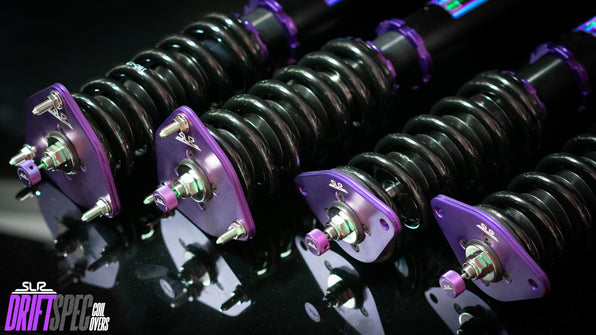
This tremendously expanded lock provides the pilot with dramatically enhanced authority during a slide, enabling it to be much more straightforward to begin a slide, sustain it through a long bend, and change smoothly from one direction to another. The improvement in controllability is nothing short of transformative. Combined with a properly selected modification is the every bit as essential upgrade to the chassis's damping system. Generic or including expensive sport adjustable suspension are just not engineered for the specific and harsh requirements of drifting. A dedicated pair of coilovers is of utmost importance. These engineered suspension components feature specific valving and spring stiffness that are optimized for the rapid mass transition that is inherent of sliding. When a operator starts a angle, the vehicle's weight is thrown rapidly to the front of the corner. Proper performance suspension handle this movement in a controllable manner, allowing the chassis to find its balance quickly and offering the pilot accurate feedback through the wheel and cockpit. They also allow for precise setting of ride height, shock absorber stiffness, and weight balance, which are all key elements of fine-tuning the vehicle's dynamics to a particular track or competition approach. As a system, a top-tier angle modification system and a properly specified set of competition suspension units form the undeniable hardware foundation upon which all future tuning is constructed.
Once the fundamental hardware is fitted, the next critical phase in the build is the meticulous adjustment of the vehicle's alignment. This is the realm of vehicle alignment optimization, a procedure that can appear intimidating to the newcomer but is, in reality, the key to transforming a collection of fast pieces into a harmonious and controllable machine. The most critical element of suspension geometry for sliding is undoubtedly camber angle. Camber angle is the tilt of the rim in relation to the upright axis when looked at from the forward of the chassis. If the top of the tire is angled inward, this is called negative camber. In sliding, negative camber on the front axle wheels is universally applied and is regarded as essential. The reason is intrinsically related to vehicle dynamics.
When a car is going around a bend at high slip angles, the body rolls to the external of the bend. This lean forces the outer front tire to reduce its ideal grip area with the asphalt. By adding an inward tilt, the tire is pre-tilted to account for this roll. As the chassis leans into the bend, the tire becomes more upright against the road surface, optimizing its bite at the exact moment when it is most required for control. Commonly, front adjustments for a competition sliding vehicle vary from approximately -3 degrees to as much as -5 degrees or even more, depending on the parameters of the vehicle setup, compound type, and operator preference. The back wheels also use negative camber, but the values are generally more modest and subtler than the front. Excessive camber at the back can make the car overly loose and challenging to predict on throttle application, as it diminishes the usable contact patch of the powered wheels during forward acceleration. Therefore, rear camber settings are commonly in the vicinity of -1 degree to -3 degrees, striking a careful equilibrium between providing adequate cornering bite to help in entering and maintaining the angle while still maintaining effective grip for exiting the corner. Camber is only one component of the larger suspension geometry equation, which furthermore includes toe, caster angle, and suspension-induced steering modification.
Toe refers to the direction of the tires when looked at from a bird's-eye view. Toe-in means the front edges of the wheels are closer together than the rear edges, while outward toe means the converse. For oversteer, a modest amount of front toe-out is often used to quicken the turn-in handling reaction, making the chassis feel more responsive and ready to begin a oversteer moment. Rear axle toe angle is typically set to zero or a very slight amount of toe-in to encourage predictability under power. caster angle is the frontwards or backwards angle of the kingpin axis when looked at from the side-on of the car. Increased positive caster increases steering feel and high-speed stability, and it also increases camber effect during steering, which is very advantageous. Tuning these settings is a complex interplay where a modification to a single parameter can and will affect the others. The traditional process for setting a vehicle's alignment for sliding has long been a tedious endeavor of experimentation and feeling. A tuner or crew would make a change based on a hunch, test the vehicle on track, rely on the operator's personal feel and feedback, and then introduce a further adjustment. This process would iterate again and again until the car felt "acceptable" or the allotted track period was exhausted. This methodology is not just extremely inefficient in terms of man-hours and costs, but it is also deeply inaccurate.
Human sensation is a infamously inconsistent data source, affected by countless elements such as tiredness, changing track surfaces, temperature, and merely the mood of the operator on that specific run. What feels "oversteery" on one lap might feel "understeery" on the next run, leading to contradictory feedback and counterproductive adjustments. This traditional challenge in chassis setup is exactly where state-of-the-art engineering tools has made its mark to completely change the landscape.
The advent and application of advanced suspension tuning applications has ushered in a radically different era for engineering and perfecting high-performance drift machines. This new generation of platforms, exemplified by innovative solutions like modern telemetry hardware, work by actively measuring the real-time mechanical movement of the car as it is piloted on the course. Unlike relying on subjective feel, these systems collect quantifiable information on critical factors such as damper compression and extension, wheel speed, lateral and longitudinal g-forces, wheel angle, and accelerator and brake pedal position. This collected information flow is then analyzed by advanced algorithms that can graph and analyze the data in a clear manner. For the very first time, engineers and builders can visualize precisely what the car is doing at every millisecond of a drift. This function revolutionizes the complete chassis setup procedure. Think about the particular challenge of dialing in the front axle negative camber for a given chassis. Rather than making a change from -3 degrees to -3.5 degrees and then running many runs to try and "sense" a difference, a suspension tuning tool can give real-time and clear feedback. The software can indicate visually how the wheel's contact patch is acting during the critical phases of a angle: turn-in, sustain, and transition. It can reveal if the existing angle is allowing the loaded tire to keep optimal loading or if the rubber is over-stressed on its outer shoulder.
The system can then suggest empirical recommendations for change. Perhaps the data reveals that the outside front tire is still overworking its edge at -3.5 degrees of camber, indicating that even more angle, say -4 degrees, might be advantageous. Conversely, the information might show that the tread is not achieving temperature or that the inside shoulder is wearing unevenly, which could point to that there is excessive angle and a small lessening back to -3.2 degrees would be better optimal. This degree of precision and useful insight was literally impossible in the days of exclusively manual adjustment.
The impact of employing a comprehensive drift telemetry system extends much further than merely dialing in alignment. It serves as an essential coilover setup tips that is customized to your exact vehicle. When setting the damping values on your suspension, instead of depending suspension tuning tool on vague advice or mimicking another car's setup, you can utilize the software to observe how the chassis is performing in response to your changes. The application can show the damper movement path over a section of track, revealing if the shocks are handling the weight transfer effectively or if they are permitting the vehicle to become unsettled excessively after a direction change. It can assist in pinpointing issues like hitting the bump stops or losing droop, permitting you to introduce informed decisions to preload settings, rebound/compression values, or stance. This process applies equally to the intricate art of car alignment tuning. In addition to camber angle, the system can give data into how modifications to toe and caster are affecting the car's handling during different phases of a slide. For instance, it can help you to ascertain the ideal amount of front axle toe-out for your particular angle kit geometry and piloting technique by showing the response time of turn-in reaction and the predictability of the vehicle at lock countersteer. This transforms the tool an extremely effective performance optimization handbook that is constantly informed by the real-world behavior of your personal car on the track. It moves the complete project from a subjective skill into a scientific optimization process.
Moreover, the utility of a system like data acquisition is in no way confined to expert tuners with large resources. For the amateur enthusiast, it serves as an powerful educational tool. It practically provides the builder with the analysis of a full-time dynamics engineer without the associated overhead. It speeds up the development time by providing definitive solutions to questions that would otherwise take countless track days of trial and error to understand. A tuner can understand how their specific vehicle reacts to different settings, developing a deeper knowledge of suspension theory in the process. It furthermore makes accessible high-level performance tuning principles, allowing all drivers with the desire to perfect their vehicle to do so in a efficient and effective fashion. This is notably significant in a discipline like drifting, where tuning knowledge has in the past been a closely guarded advantage among top crews. Now, that power can be in the hands of every dedicated builder.
In conclusion, the path to building and dialing in the ultimate championship-contending drift coilover setup tips car is a multi-faceted mission that perfectly combines classic hardware principles with revolutionary telemetry technology. It starts with the strategic choice of a legendary chassis, then enhanced by the application of critical drift-spec parts like maximum-angle angle modification systems and properly specified performance coilovers. The journey then progresses into the precision realm of alignment optimization, where values like camber, toe setting, and caster are meticulously set to complement the chassis's new geometry and the operator's specific style. Ultimately, and what really differentiates the modern approach from the old coilover setup tips ways, is the adoption of a powerful drift telemetry software. This tool removes the uncertainty and trial and error of only subjective tuning by providing quantifiable, live telemetry on how the chassis is really functioning. It functions as an incredible suspension tuning tool, a comprehensive coilover setup manual, and a comprehensive chassis development system. As a complete package, this complete philosophy leads to that all component of the competition vehicle—from the pick of the car to the most minute tweak on the suspension—is perfected for ultimate success on the track. It represents the complete maturation of the discipline of sliding, bridging raw driving skill with precise suspension engineering to forge the perfect dominant cars imaginable.